Expedited Services AvailableRequest a Quote
Enclosure Categories
Specify & Design Your Enclosure SolutionConfiguration
Configuration
ENCLOSURE
Step 1: Use Product Filter (below)
Step 2: Select Options & Download Your Pre-Engineered Spec Drawing
How to Specify & Design "Mobile" Enclosures & "Portable" Server Rack Cabinets
1. Use the Filter System: Select "Mobile" Design Configuration
Choose "Mobile" unless there's a better configuration option.
You can toggle between options: wall mount, floor mount, free standing, etc.
2. Select Enclosure "Type" for the Direct Application or Usage
Server Rack Cabinet: 19 inch rack for IT networks or switch gear
Electrical Enclosure: used for Electrical Power, PLC, VFD's , wiring
Submersible Enclosure: Not applicable
Junction & Pull Box: Not applicable
Wireway & Trough: Not applicable
3. Specify Enclosure "Material" and Finish Coating
Powder Coat Steel: Good for most indoor or outdoor applications
Powder Coat Aluminum: Light weight, mild corrosion protection
Stainless Steel (304, 316): Strong & Corrosion Resistance (passivated)
4. Specify NEMA or IP Protection "Ratings" for Application
Rain Resistant Ratings: NEMA 3 (dust-proof), NEMA 3R (rain only)
Rain Resistant Rating with corrosion protection NEMA 3X, NEMA 3RX
Washdown Protection Rating: NEMA 4, NEMA 4X (corrosion protection)
Submersible Waterproof : Not applicable, Not available
Dust Resistant Rating: NEMA 12 (dust-proof seals, water drip-proof)
5. Selection Product Brand "Series" as an Option (not required).
If applicable, select a product that fits your design application
6. Next, Go Find the Enclosure Size in H x W x D dimension & options that you want.
Don't Forget to "Download" a Pre-Engineered Drawing that will save you a lot of design time for mobile enclosure or portable server rack cabinet.
Make sure to confirm the enclosure H x W x D dimensions
Review all the options on the drawing check list for the solution
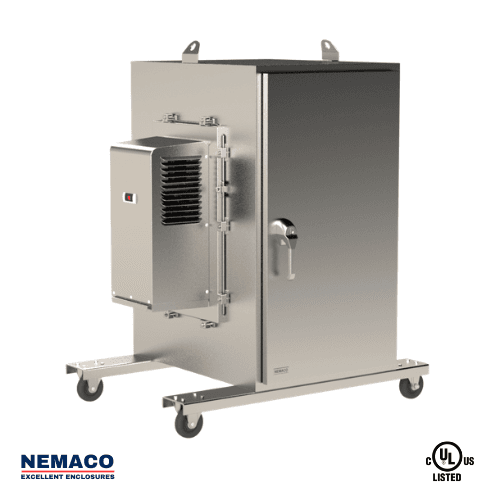
Specify mobile NEMA enclosures and portable server cabinets optimized for transit mobility. This series is uniquely built to safeguard electrical power subsystems, critical communications gear, field repair diagnostic arrays, and mobile remote data tracking hubs.
Engineered for High-Value Subsystems: Ideal for mobile electronic diagnostic repair systems, remote portable analyzers, and portable UPS systems with heavy battery banks.
Heavy-Duty Caster Footprints: Configured with robust, high-capacity casters for seamless transport across uneven facility floors or field environment terrains.
Download Pre-Engineered Drawings: Select your required dimensions below to instantly download your technical specification drawing and skip manual drafting.
Mobile network enclosure and portable server rack cabinet available in 12u, 13u, 14u, 15u, 16u, 17u, 18,u, 19u, 20u, 22u, 24u, 25u, 27u, 30u, 39u sizes"
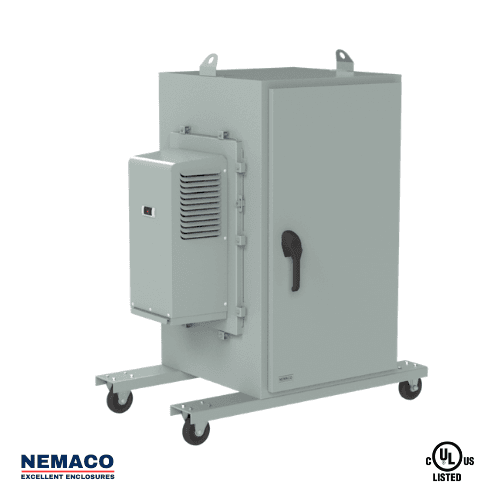
Server Rack Cabinet
ServerPro™ 4
Single Bay Mobile
1 Front Door
Material: Galvanized Steel or Aluminum
Standard Finish: Powder Coat ANSI 61 Gray
Dimensions [in.]: H:24–72, W:24, D:16–30
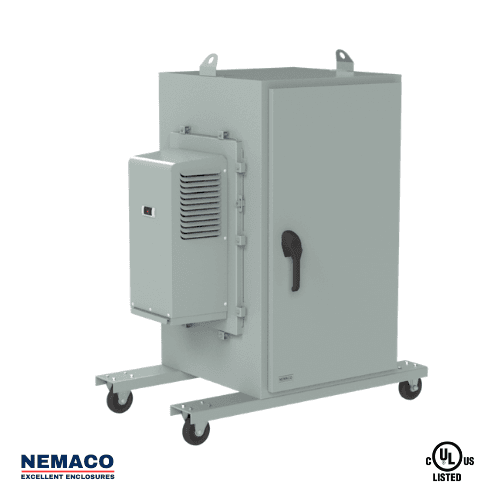
Server Rack Cabinet
ServerPro™ 4
Single Bay Mobile
2 Doors (Front & Rear)
Material: Galvanized Steel or Aluminum
Standard Finish: Powder Coat ANSI 61 Gray
Dimensions [in.]: H:24–72, W:24, D:24–42
Server Rack Cabinet
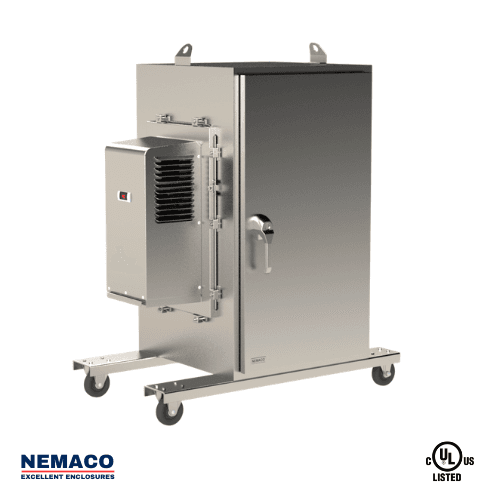
ServerPro™ 4X
Single Bay Mobile
1 Front Door
Material: Stainless Steel
Standard Finish: #4 Grain Finish
Dimensions [in.]: H:24–72, W:24, D:16–30
BLOG
May 25, 2026
Server Rack Cabinet Sizes: Standard Dimensions, Depth Options, and Selection Guide
Learn standard server rack cabinet sizes including 42U height, 19-inch width, and depth options from 24 to 42 inches, plus how to choose the right configuration based on equipment, airflow, and environment.
April 25, 2026
How to Choose the Right Electrical Enclosure Material | Engineering Selection Guide
Select electrical enclosure materials based on environmental exposure, corrosion mechanisms, thermal behavior, and long-term performance. Compare steel, aluminum, stainless steel, and fiberglass using real-world engineering criteria.
April 24, 2026
NEMA 4X vs NEMA 6P for Coastal Applications: How to Choose the Right Enclosure
Compare NEMA 4X vs NEMA 6P enclosures for coastal and offshore environments. Learn when to choose each based on corrosion, washdown, and submersion risk.