What Are Waterproof Submersible Enclosures?
Waterproof submersible enclosures are engineered cabinets designed to protect electrical and electronic equipment from full water immersion. Unlike standard weatherproof enclosures that only guard against rain and hose-directed water, submersible enclosures rated NEMA 6 and NEMA 6P must withstand prolonged submersion under water — making them essential for flood-prone installations, underground vaults, and waterfront infrastructure.
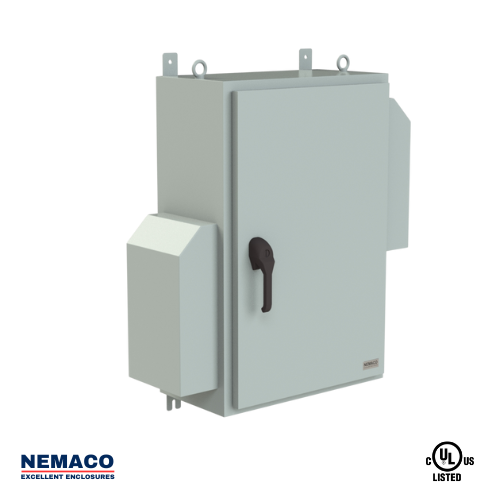
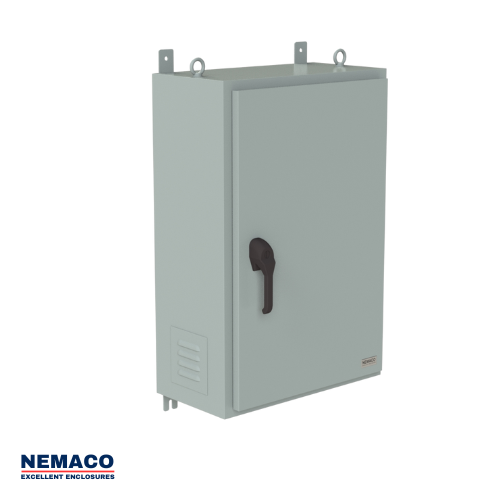
Nemaco provides submersible waterproof enclosure solutions for critical infrastructure security applications (CISA) across the United States. Our product line includes engineered solutions in stainless steel, powder-coated aluminum, and FRP (fiberglass) for junction boxes, pull boxes, wireways, electrical control cabinets, and specialized equipment — all built to meet NEMA 250 standards.
UL Listed Type 6 and Type 6P Enclosure Solutions
Nemaco offers UL Listed Type 6 and Type 6P solutions manufactured per NEMA 250 and UL 50/50E specifications. These enclosures are engineered to withstand adverse weather conditions and complete water submersion. When installed correctly per factory technical specifications and National Electrical Code standards, there will be no water inside any submersible cabinet.
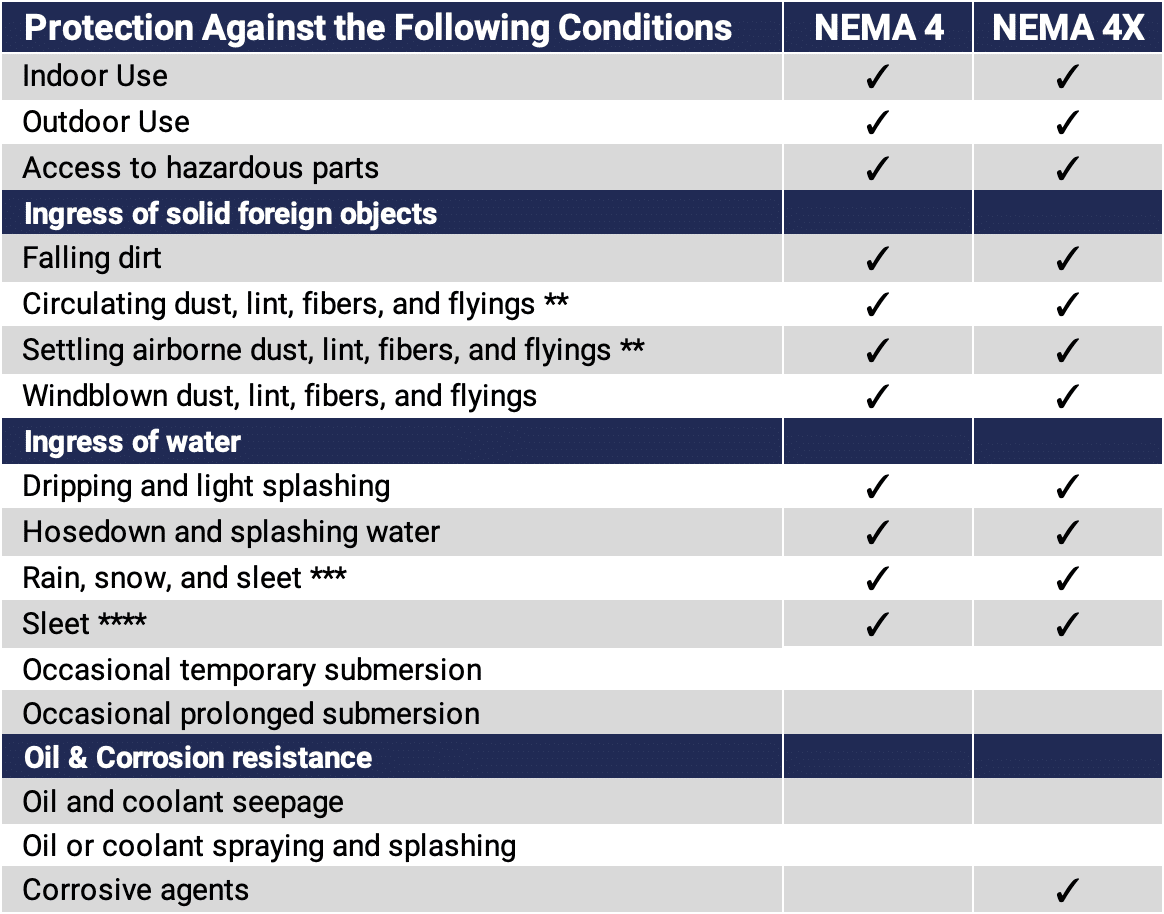
The distinction between NEMA 6 and NEMA 6P matters for specifying engineers. NEMA 6 enclosures provide temporary submersion protection — they must prevent water ingress when submerged at a limited depth for a limited time. NEMA 6P enclosures go further, providing protection against prolonged submersion at a specified depth. Both ratings exceed the requirements of NEMA 4X enclosures, which protect against hose-directed water but are not rated for submersion.
NEMA and IP Rating Comparison for Waterproof Enclosures
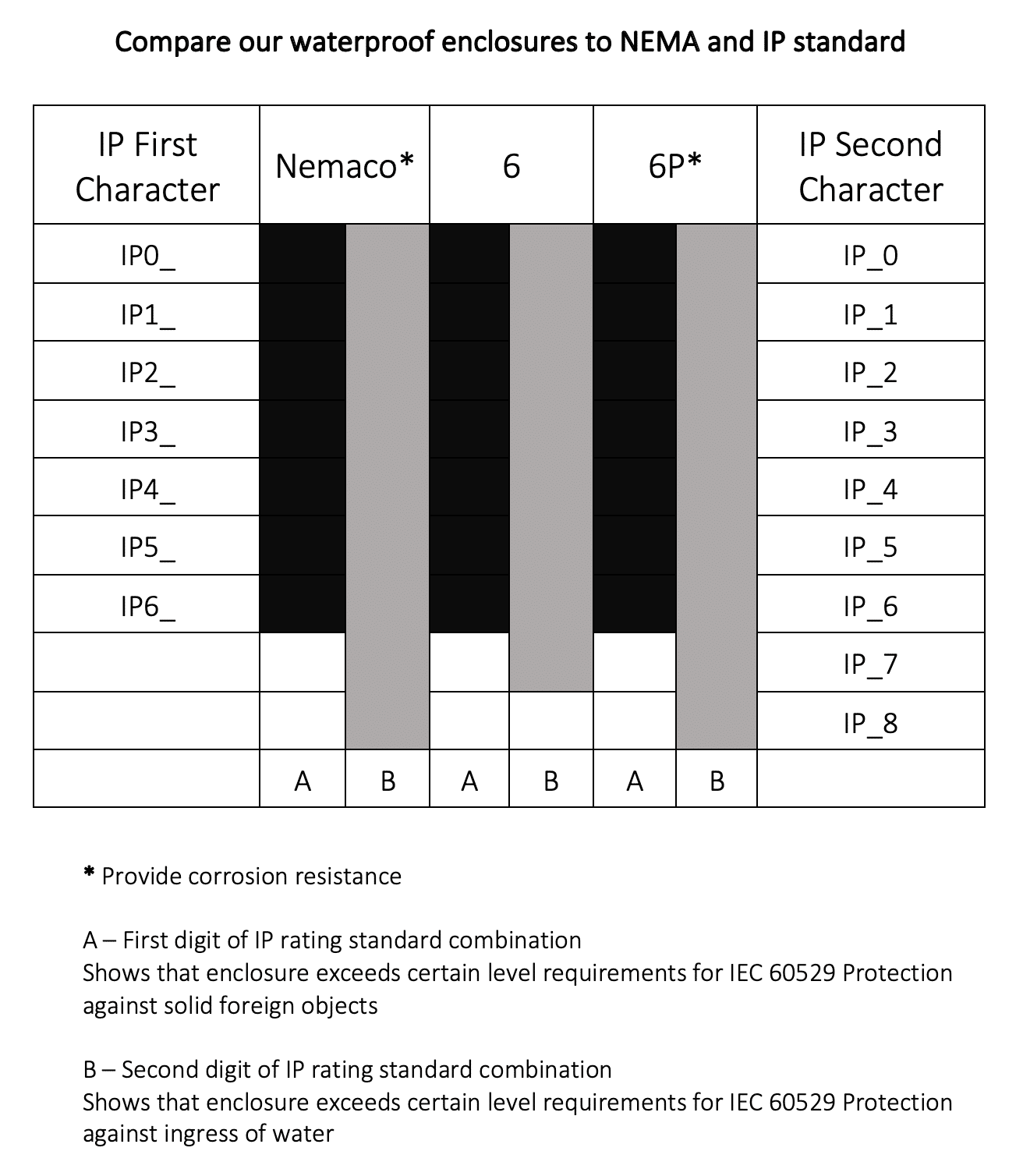
Understanding the relationship between NEMA and IP (Ingress Protection) ratings helps engineers specify the right enclosure for international projects. Here is how submersible ratings align:
- NEMA 6 — Comparable to IP67. Protection against temporary submersion (up to 1 meter for 30 minutes per IEC 60529). NEMA 6 adds additional requirements for corrosion resistance, gasket aging, and external icing.
- NEMA 6P — Comparable to IP68. Protection against prolonged submersion at greater depths (conditions specified by manufacturer). NEMA 6P similarly includes environmental aging requirements beyond the IP standard.
It is important to note that NEMA ratings are not directly interchangeable with IP ratings. NEMA standards include additional tests for corrosion, gasket deterioration, and environmental exposure that IP ratings do not require. A NEMA 6P enclosure exceeds IP68 requirements, but an IP68 enclosure does not automatically meet NEMA 6P standards.
Enclosure Hardware and Seal Options
Achieving a waterproof seal depends on more than the enclosure body itself. Every penetration point — conduit entry, cable pass-through, door hinge, and window — must maintain the submersion rating. Nemaco offers the following hardware and seal options for submersible enclosures:
- Conduit hubs — Threaded entries with compression seals rated for submersion
- Cable glands — Strain-relief fittings that maintain IP68 sealing around individual cables
- Piping and fittings — Schedule 40/80 compatible entries for plumbed installations
- Door floating hinges — Engineered to maintain gasket compression across the full door surface
- Roxtec industrial seals — Modular sealing systems for multi-cable penetrations
- Alternate gasket solutions — Silicone, EPDM, and neoprene options based on chemical exposure requirements
- Door screw captive hardware — Prevents hardware loss during field service, maintains consistent torque
- Clear windows — Polycarbonate viewing panels for non-UL applications requiring visual equipment monitoring
- Dual rated NEMA 6P / NEMA 4X seals — For cabinets that must meet multiple environmental ratings simultaneously
100% Waterproof Performance Tested — Quality Guaranteed
Every Nemaco waterproof enclosure undergoes a full 24-hour simulated environmental test before shipping. This is not a sample-based quality program — every single unit is individually tested. The acceptance criteria are absolute: no leaks permitted on gaskets, conduit hubs, pipe fittings, or windows.
All waterproof enclosures are tested to pass NEMA 6 and 6P criteria per UL 50/50E standards, providing verified protection against water submersion under 6 feet (1.8 meters) for 24 hours. This testing protocol exceeds the minimum requirements of the standard, giving engineers and facility managers confidence that the enclosure will perform in real-world flood, storm surge, and underground vault conditions.
Testing is performed at Nemaco's manufacturing facility in Houston, Texas, using purpose-built submersion tanks. Each enclosure is fully assembled with all specified hardware, conduit entries, and seals installed before testing — the same configuration that will be shipped to the job site.
Material Options for Waterproof Enclosures
Choosing the right material is critical for long-term waterproof enclosure performance. The enclosure body must resist corrosion from the same water and chemicals it is designed to keep out. Nemaco manufactures submersible enclosures in three material families.
Stainless Steel
Stainless steel enclosures offer the highest corrosion resistance for metallic submersible enclosures. Nemaco offers four stainless steel grades:
- 304 Stainless Steel — General-purpose austenitic stainless with excellent corrosion resistance for most industrial environments
- 304L Stainless Steel — Low-carbon variant of 304 that reduces carbide precipitation during welding, improving weld-zone corrosion resistance
- 316 Stainless Steel — Contains higher concentrations of nickel, molybdenum, and chromium than 304, providing superior resistance to chlorides and marine environments
- 316L Stainless Steel — Low-carbon variant of 316 for improved weldability in heavy-gauge enclosure fabrication
Type 316 stainless steel is the recommended choice for installations exposed to salt water, coastal atmospheres, or chemical processing environments. Type 304 provides meaningful cost savings for applications where chloride exposure is not a primary concern.
Aluminum Alloy
Aluminum enclosures offer a compelling combination of light weight, corrosion resistance, and thermal performance for submersible applications. Nemaco uses two aluminum alloys:
- 5052 Aluminum — Excellent corrosion resistance, particularly in marine environments; good formability for complex enclosure geometries
- 6061 Aluminum — Higher strength with good corrosion resistance; commonly specified for structural enclosure frames and mounting systems
Aluminum submersible enclosures are widely specified for telecommunications cabinets, lift station control panels, traffic control enclosures, and water/wastewater treatment facilities. Key advantages include lightweight construction for easier field installation, excellent heat dissipation for temperature-sensitive electronics, and inherent corrosion resistance that outperforms carbon steel without additional coatings.
Powder Coat Surface Protection
All aluminum NEMA 6 and 6P enclosures feature UL-listed powder coat finishes that provide an additional barrier against environmental exposure. Standard colors include white, light grey, dark gray, and black. Custom colors — including hunter green, blue, yellow, and orange — are available for projects requiring visual identification or brand-specific aesthetics.
The powder coat layer serves a dual purpose: it adds UV resistance for outdoor installations and provides a sacrificial barrier that absorbs minor impacts and abrasion before the base aluminum is exposed.
Applications for Waterproof Submersible Enclosures
Submersible enclosures protect critical equipment in environments where water exposure is unavoidable or unpredictable:
- Underground electrical vaults — Junction and pull boxes in below-grade utility runs that flood during heavy rain or water main breaks
- Wastewater treatment plants — Control panels and instrumentation near clarifiers, aeration basins, and pump stations
- Coastal and marine infrastructure — Traffic signals, navigation aids, and communication equipment subject to storm surge and tidal flooding
- Lift stations — Pump control cabinets in sanitary sewer lift stations where wet-well overflow is a design consideration
- Oil and gas facilities — Instrumentation enclosures in areas with chemical wash-down or deluge fire suppression systems
- Transportation infrastructure — Signal and communication cabinets in highway underpasses, tunnels, and flood-zone bridge approaches
How to Specify a Waterproof Submersible Enclosure
When specifying a submersible enclosure for your project, consider these key factors:
- Submersion depth and duration — Determine the maximum expected water level and how long the enclosure may remain submerged. This drives the choice between NEMA 6 and NEMA 6P.
- Chemical exposure — Identify any chemicals, salts, or contaminants in the water. This determines material selection (304 vs. 316 stainless, aluminum alloy grade).
- Number and size of cable entries — Each penetration must maintain the submersion rating. Plan conduit and cable gland layouts early in the design process.
- Thermal management — Sealed enclosures limit natural convection. Consider heat load from internal equipment and whether active cooling is required.
- Mounting configuration — Wall mount, floor mount, or pad mount — each has different implications for flood exposure and maintenance access.
- Compliance requirements — Confirm whether the project requires UL listing, specific NEMA ratings, or Buy America Act compliance.
Nemaco's engineering team works with specifiers to configure waterproof enclosures for exact project requirements — from material selection and hardware specification through submersion testing and documentation. Contact our team to discuss your submersible enclosure application.