What Are IP Ratings?
IP ratings — short for Ingress Protection (also called International Protection) — are a standardized system that classifies how effectively an electrical enclosure guards against the intrusion of solid particles and liquids. Defined by the IEC 60529 standard (and its European equivalent EN 60529), IP ratings give engineers, specifiers, and procurement teams an objective way to compare enclosure protection levels across manufacturers and product lines.
An IP rating consists of the letters "IP" followed by two numerical digits — for example, IP67. The first digit indicates protection against solid objects such as dust, body parts, and debris. The second digit indicates protection against liquids, ranging from light dripping water all the way to continuous submersion. Understanding these two digits is essential when selecting enclosures for industrial, outdoor, or harsh-environment deployments.
At Nemaco, we manufacture enclosures across a range of IP ratings — including IP24, IP54, IP66, IP67, and IP68 — to meet the protection requirements of industries such as oil and gas, telecommunications, data centers, food processing, and marine applications. Every enclosure we build is designed and fabricated in Houston, Texas, with full control over materials, gasketing, and sealing to ensure the rated protection level is met.
How to Read an IP Code
The IP code structure is straightforward once you know what each position represents:
- IP — the fixed prefix standing for Ingress Protection or International Protection
- First digit (0–6) — level of protection against solid particles, from no protection (0) to complete dust-tight sealing (6)
- Second digit (0–9K) — level of protection against liquid ingress, from no protection (0) to high-pressure, high-temperature water jets (9K)
- Optional letter suffix — supplementary information such as oil resistance (f), high voltage (H), or weather conditions (W)
For example, an IP67 enclosure offers level 6 solid protection (completely dust-tight) and level 7 liquid protection (withstands temporary immersion in water up to 1 meter). An IP68 enclosure goes further — it is rated for continuous submersion beyond 1 meter under conditions specified by the manufacturer.
First Digit: Solid Particle Protection
The first digit of an IP rating ranges from 0 to 6 and describes the enclosure's resistance to solid objects and dust. Higher numbers mean greater protection.
| Level | Object Size | Protection Description |
|---|---|---|
| 0 | — | No protection against contact or ingress of solid objects |
| 1 | >50 mm | Protection against large body surfaces (e.g., back of hand). No protection against deliberate contact |
| 2 | >12.5 mm | Protection against fingers or similar-sized objects |
| 3 | >2.5 mm | Protection against tools, thick wires, and similar objects |
| 4 | >1 mm | Protection against most wires, slender screws, and large insects |
| 5 | Dust protected | Ingress of dust is not fully prevented but limited to amounts that will not interfere with the satisfactory operation of equipment |
| 6 | Dust tight | Complete protection against dust. Tested under vacuum conditions for up to 8 hours with no ingress |
For most industrial enclosure applications, a first digit of 5 (dust-protected) or 6 (dust-tight) is required. Nemaco's NEMA 4X enclosures, for instance, provide full dust-tight protection equivalent to IP66 solid protection.
Second Digit: Liquid Ingress Protection
The second digit ranges from 0 to 9K and describes the enclosure's resistance to water and other liquids. This is typically the more critical specification for outdoor, washdown, and submersible applications.
| Level | Protection Type | Test Conditions |
|---|---|---|
| 0 | None | No protection against water |
| 1 | Dripping water | Vertically falling drops cause no harmful effects when enclosure is in normal position |
| 2 | Dripping water (tilted 15°) | Vertically falling drops cause no harmful effects when enclosure is tilted up to 15° from normal position. Tested in four positions across two axes |
| 3 | Spraying water | Water spray at up to 60° from vertical has no harmful effect. 5-minute test duration |
| 4 | Splashing water | Water splashing from any direction has no harmful effect. 10-minute test duration |
| 5 | Water jets | Water projected from a 6.3 mm nozzle from any direction has no harmful effect |
| 6 | Powerful water jets | Water projected from a 12.5 mm nozzle from any direction has no harmful effect |
| 6K | Powerful water jets (increased pressure) | Water from a 6.3 mm nozzle at elevated pressure per DIN 40050 standard |
| 7 | Immersion up to 1 m | Water ingress prevented during temporary submersion at up to 1 meter depth for 30 minutes |
| 8 | Immersion beyond 1 m | Suitable for continuous submersion under conditions specified by the manufacturer. Depth and duration vary by product |
| 9K | High-pressure, high-temperature jets | Close-range, high-pressure (80–100 bar), high-temperature (80°C) spray from specific nozzle configurations |
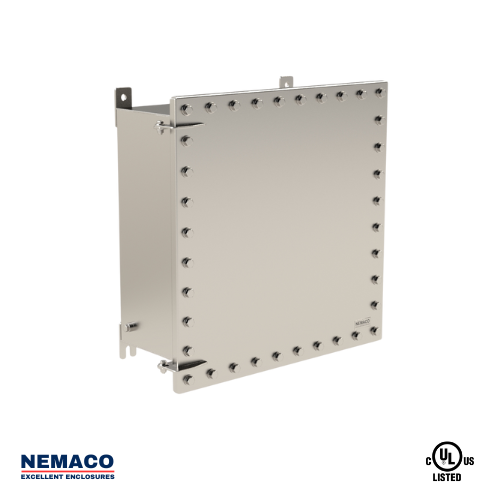
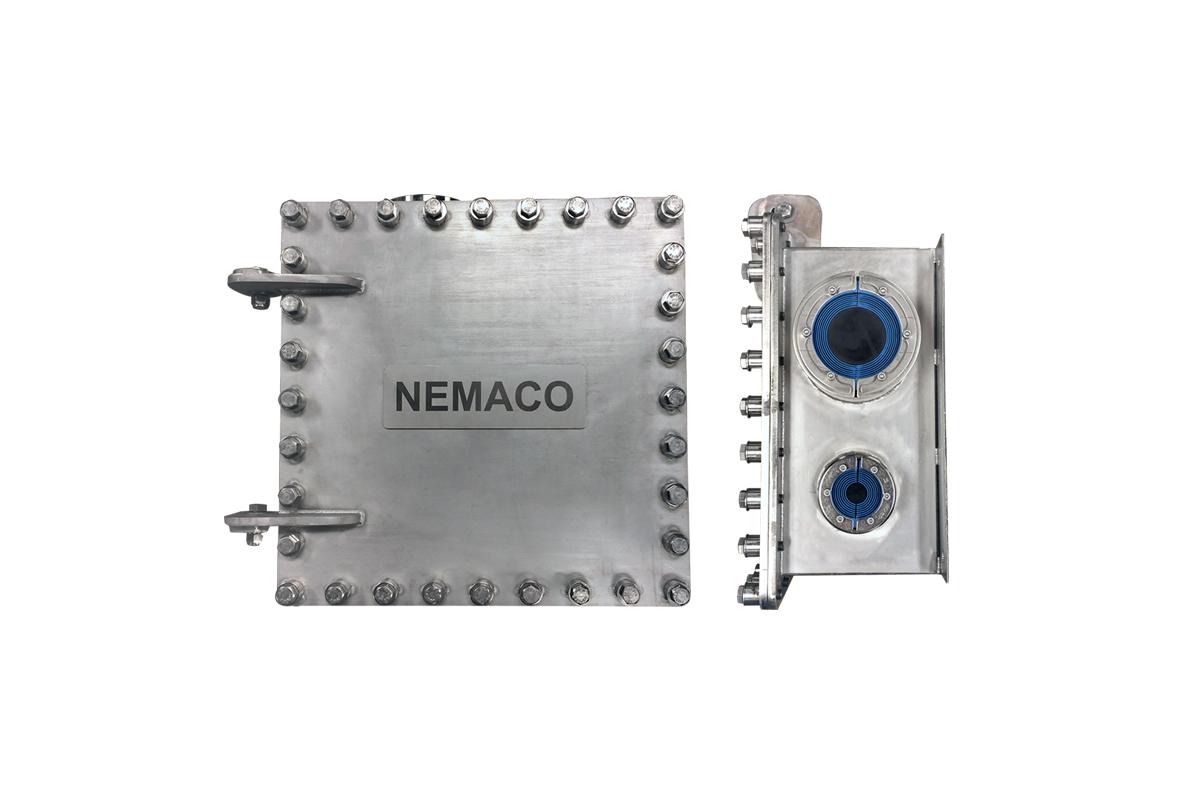
Nemaco's submersible waterproof enclosures are rated IP67 and IP68, making them suitable for applications where temporary or continuous water immersion is expected — such as underground vaults, marine environments, and flood-prone installations.
Additional Letter Codes
Some IP ratings include an optional letter suffix that provides supplementary protection information beyond the two-digit code:
| Letter | Meaning |
|---|---|
| f | Oil resistant |
| H | High voltage device |
| M | Device was moving during liquid test (e.g., rotating equipment) |
| S | Device was standing still during liquid test |
| W | Tested under specified weather conditions |
IP Ratings vs. NEMA Ratings
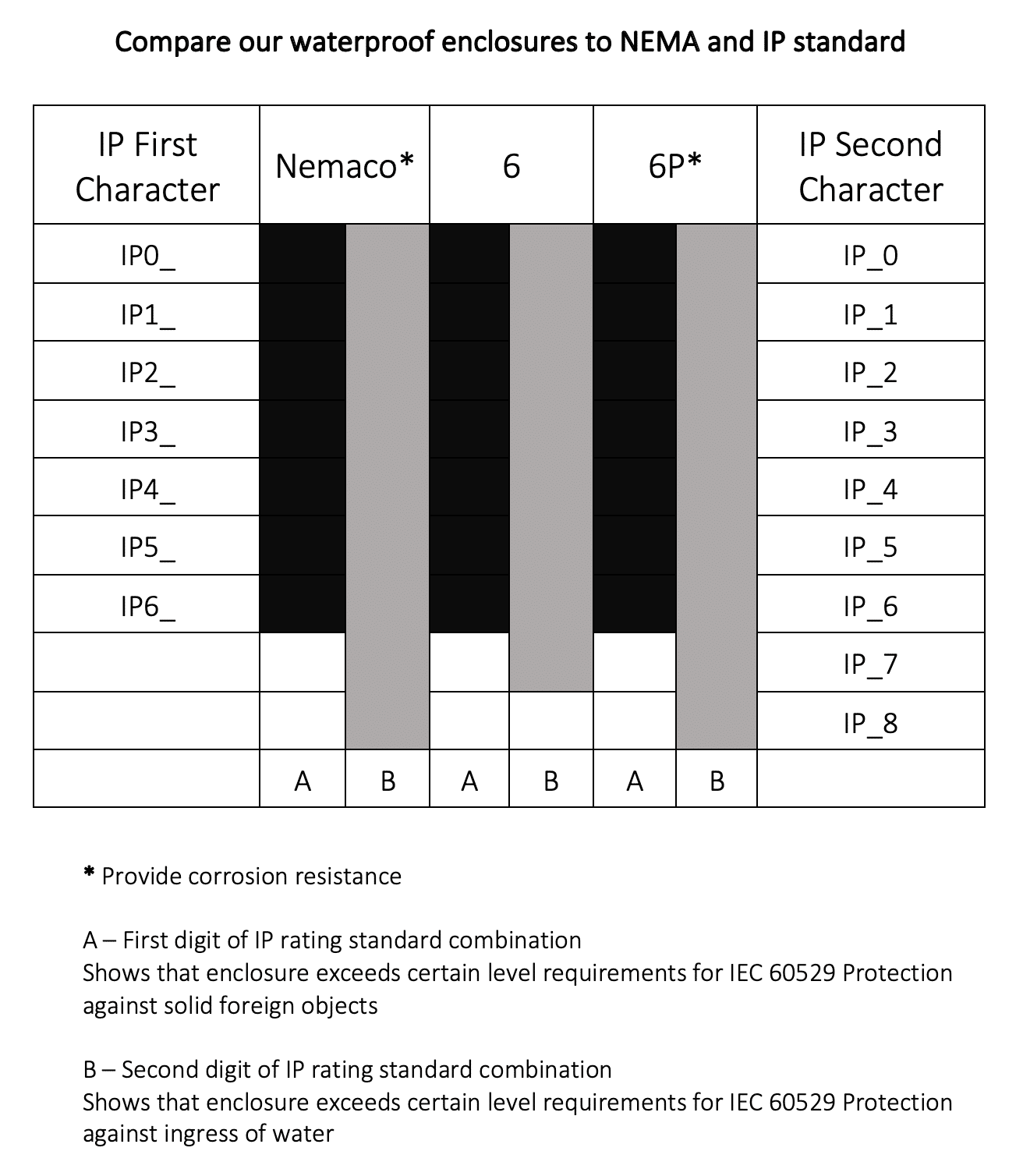
While IP ratings are internationally recognized under IEC 60529, NEMA ratings are the North American standard (NEMA 250) and include additional performance criteria beyond ingress protection — such as corrosion resistance, gasket aging, external icing, and construction materials. Because of this, NEMA ratings generally provide more comprehensive protection requirements than IP ratings alone.
A NEMA 4X enclosure, for example, offers protection roughly equivalent to IP66, but also guarantees corrosion resistance (typically through stainless steel or fiberglass construction) and resistance to external icing — factors that an IP66 rating does not address. For a detailed comparison, see our NEMA Ratings Chart.
When specifying enclosures, it is important to consider whether your application requires IP-only compliance (common in European and international projects) or full NEMA compliance (standard in North America). Nemaco enclosures are built to meet both standards where applicable.
Choosing the Right IP Rating for Your Application
Selecting the correct IP rating depends on the environment where the enclosure will be installed:
- Indoor, climate-controlled spaces — IP20 to IP40 is typically sufficient for protection against accidental contact and small debris
- Indoor industrial (dust, mild moisture) — IP54 or IP55 provides dust protection and splash resistance for factory floors and workshops
- Outdoor, exposed to weather — IP65 or IP66 ensures dust-tight protection with resistance to water jets from hose-down or heavy rain
- Washdown environments (food processing, pharmaceutical) — IP66 or IP69K is required for high-pressure, high-temperature cleaning cycles
- Temporary water submersion — IP67 protects against immersion up to 1 meter for 30 minutes, suitable for flood zones and underground vaults
- Continuous submersion — IP68 is required for permanent underwater installations; depth and duration are specified by the manufacturer
Nemaco offers enclosures in stainless steel, aluminum, carbon steel, and fiberglass (FRP) — each available with the gasketing, sealing, and hardware needed to achieve your target IP rating. Need a configuration that is not in our standard catalog? Our custom enclosure program can build to your exact specifications.