Total Cost of Ownership for Electrical Enclosures | Engineering & Cost Analysis
Understand total cost of ownership for electrical enclosures, including environmental exposure, heat load, maintenance, and failure costs. Learn how design decisions impact long-term performance and cost.
Total cost of ownership (TCO) for electrical enclosures is not defined by the purchase price. It is defined by how the enclosure performs over time under real-world environmental conditions. The initial cost is often only a small portion of the total investment. Operating costs, maintenance, repairs due to environmental exposure, and failure-related expenses accumulate over the life of the enclosure, often exceeding the original purchase price multiple times over.
Selecting an enclosure based on purchase price alone, without accounting for environmental exposure, thermal performance, and maintenance requirements, routinely results in higher total expenditure over the lifespan of the installation.
The Iceberg Model: What You Pay vs. What It Actually Costs
Most of the cost of an electrical enclosure is not visible at the time of purchase.
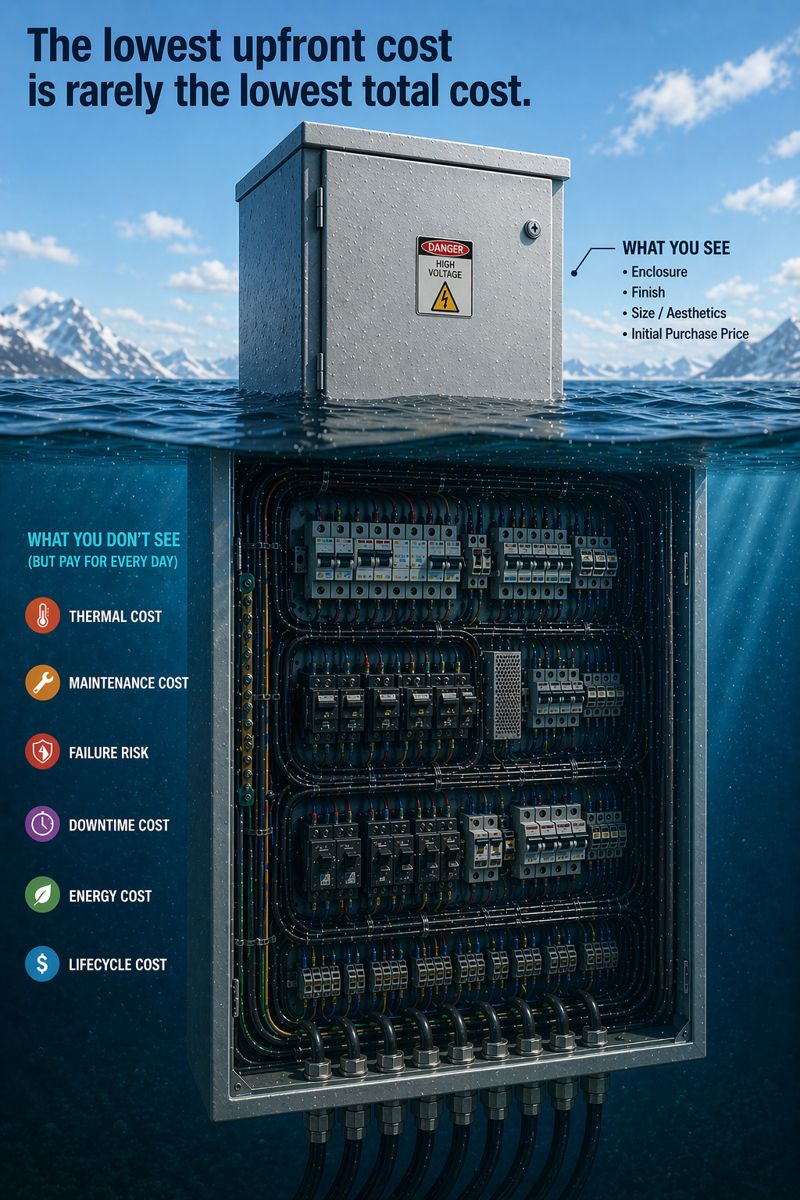
Visible Costs (Upfront)
Purchase price
Installation
Hidden Costs (Lifecycle)
Energy consumption
Maintenance and inspection
Component failure
Downtime and lost production
Purchase price is often estimated to be only 10 to 15% of the total cost. The remaining cost is incurred over time as the enclosure interacts with its environment. This is why two enclosures with similar upfront pricing can have completely different long-term costs.
As an example, a $2,000 enclosure installed in a coastal environment without adequate corrosion protection may require gasket replacement, coating restoration, and hardware replacement within 3 to 5 years. The same installation with a properly specified 316 stainless steel or fiberglass enclosure may require only scheduled inspections over the same period. The price difference at purchase is rarely as large as the cost difference at year 5.
The lowest upfront cost is rarely the lowest total cost.
Standard TCO Formula
TCO is typically defined as:
Initial + Operating + Maintenance + Downtime + Lost Production - Resale
This formula provides a financial structure, but it does not explain what actually drives these costs in electrical enclosures.
What TCO Actually Means for Electrical Enclosures
For enclosures, cost is driven by exposure and performance over time. A more practical way of thinking about it:
TCO = Cost of surviving the environment over time
Electrical Enclosure TCO Framework
To understand where cost actually comes from, TCO can be broken down into the factors that drive it:
TCO = Initial Cost + Environmental Cost + Thermal Cost + Maintenance Cost + Failure Cost + Downtime
Where the Costs Actually Come From
Cost Category | What Drives It | What It Looks Like in the Field |
Initial Cost | Purchase + installation | Equipment and labor |
Environmental Cost | ||
Heat load, solar gain, poor cooling | Energy usage, overheating | |
Gasket replacement, filter changes | ||
Failure Cost | Design mismatch, material limits | Seal failure, component damage |
System interruption | Lost production, emergency repair |
Environmental Exposure is a Cost Multiplier
Environmental conditions do not just affect performance. They directly impact cost.
How Exposure Increases Cost
Corrosion in coastal environments can reduce enclosure service life from 20 years to fewer than 5 if material selection does not account for chloride exposure. Pitting and crevice corrosion at seams and fastener points often go undetected until structural integrity is compromised.
UV exposure degrades polymer-based coatings and unstabilized plastics within 2 to 4 years in high-UV environments, requiring recoating or full enclosure replacement ahead of schedule.
Condensation forming on internal surfaces introduces moisture directly onto conductive components, leading to shorting, insulation breakdown, and corrosion that is difficult to detect before failure occurs.
The more aggressive the environment, the faster costs accumulate.
Thermal Load: Where Energy Costs Add Up
Thermal performance is one of the most overlooked contributors to TCO, and heat load is directly tied to energy consumption and long-term system performance.
BTU/hr = Watts × 3.41
Where heat load is expressed in BTU/hr and power is the electrical input in watts.
Required airflow can be estimated using:
CFM = BTU/hr ÷ (1.08 × ΔT)
Where CFM is airflow in cubic feet per minute, BTU/hr is the heat load, and ΔT is the allowable temperature rise above ambient.
An undersized cooling system running continuously to compensate for an under-calculated heat load is one of the most common sources of avoidable energy cost in enclosure installations.
What Happens When Heat is Miscalculated
Cooling systems run continuously
Energy consumption increases
Component lifespan decreases
Over time, these effects compound into higher operating and replacement costs.
Thermal Issue | Long-Term Cost Impact |
|---|---|
Continuous cooling operation | Higher energy cost |
Elevated internal temperatures | Reduced component lifespan |
Poor airflow | |
Undersized cooling system | Premature equipment failure |
Excess humidity |
To better understand enclosure cooling strategies and heat load management, read Air Conditioners vs Filtered Fan Cooling for Electrical Enclosures: What’s the Difference?
Failure Mechanisms Drive Long-Term Cost
In electrical enclosures, failure rarely occurs as a single catastrophic event. It develops incrementally as environmental exposure accumulates, materials degrade, and design limitations are reached.
Common Cost-Driving Failures
Seal performance failure leading to moisture ingress
Corrosion reducing structural integrity
Thermal cycling degrading gaskets and fasteners
Material incompatibility causing premature breakdowns
Each of these creates additional cost through repair, replacement, and system disruption.
Failure is not a single event, but a process.
Improper environmental protection and thermal management are among the most common causes of enclosure failure. Learn more in Common Causes of Electrical Enclosure Failure.
Condensation: The Hidden Downtime Risk
Even in controlled environments, condensation can form when internal temperatures drop below the dew point.
Approximate Dew Point (°F) = Air Temperature − ((100 − Relative Humidity) ÷ 5)
Where:
Air Temperature = current air temperature (°F)
Relative Humidity = current relative humidity (%)
Result = approximate temperature at which condensation may form (°F)
Why Condensation is Expensive
Electrical components are exposed to moisture
Shorting and insulation failure can occur
Systems may shut down unexpectedly
These failures often result in unplanned downtime, which is one of the most expensive components of TCO.
Anti-condensation heaters are one of the most cost-effective mitigations available. A heater sized to maintain internal temperature 2 to 5 degrees above ambient dew point typically costs less than $100 and can prevent thousands of dollars in component damage and unplanned downtime. Desiccant breathers provide additional protection in sealed enclosures by absorbing moisture from pressure equalization airflow.
Maintenance is Predictable. Failure is Not.
Planned Maintenance Costs
Scheduled inspections
Gasket replacement cycles
Filter maintenance
Cooling system upkeep
Unplanned Failure Costs
Emergency repairs
Equipment replacement
System outages
Labor and response costs
The goal is not to eliminate maintenance, but to prevent failure. Planned maintenance intervals for gaskets, filters, and cooling systems are established based on enclosure type and environment. When those intervals are skipped or underestimated, the cost of the resulting failure consistently exceeds the cost of the maintenance that would have prevented it.
Design Decisions Determine Lifecycle Cost
The most important factor in TCO is not what happens during operation. It is what is decided before installation.
What is Decided Early
Material selection and corrosion resistance: specifying 304 stainless in a chloride environment instead of 316 can reduce service life by half
Thermal management capability: an undersized cooling system increases energy cost and accelerates component degradation
Sealing system selection: gasket material and compression specifications must match the environmental conditions and thermal cycling the enclosure will experience
Resistance to environmental exposure: materials selected for initial cost rather than environmental compatibility accumulate maintenance and replacement costs within the first service cycle
Poor decisions at this stage lock in higher costs for the life of the enclosure.
For more information about selecting materials based on environmental exposure and long-term durability, read How to Choose the Right Electrical Enclosure Material | Engineering Selection Guide.
Indoor vs Outdoor TCO Differences
Factor | Indoor Impact | Outdoor Impact |
Moderate | High, variable | |
Temperature | Stable | Wide swings |
None | Continuous | |
Low | Elevated | |
Cooling Demand | Lower | Significantly higher |
Outdoor enclosures typically have higher operating, maintenance, and failure-related costs due to increased environmental exposure. The gap between indoor and outdoor TCO widens significantly in coastal, high-UV, or chemically aggressive environments where multiple exposure factors act simultaneously.
The NEMACO™ Approach to Reducing TCO
At NEMACO™, enclosure design is based on how systems perform under real-world conditions, not minimum specifications.
What We Focus On
Environmental exposure and long-term material behavior
Thermal performance and energy efficiency
Sealing systems that maintain performance over time
Design decisions that reduce failure risk
NEMACO™ enclosure are engineered to perform under combined environmental stress, not isolated test conditions, and are backed by a 5 to 15-year warranty depending on configuration, providing added confidence in long-term durability and performance for demanding environments.
Making the Right Investment
Total cost of ownership is not a financial abstraction. It is the result of how an enclosure performs over time. The lowest upfront cost is rarely the lowest total cost.
What the Best Investment Looks Like
Matches the environment it will operate in
Minimizes maintenance and failure risk
Performs consistently over its full lifecycle
Enclosures that meet these criteria consistently outperform lower-cost alternatives when measured against actual lifecycle expenditure.
Frequently Asked Questions (FAQs)
What percentage of an enclosure's total cost is typically the purchase price itself?
Purchase price is often estimated to be only 10 to 15 percent of total cost. The remaining cost is incurred over time as the enclosure interacts with its environment, through energy consumption, maintenance, material degradation, and potential downtime.
How much can a $100 anti-condensation heater actually save in avoided damage?
A heater sized to maintain internal temperature 2 to 5 degrees above ambient dew point typically costs less than $100 and can prevent thousands of dollars in component damage and unplanned downtime, making it one of the most cost-effective mitigations available.
Why can two enclosures with similar upfront pricing end up costing very different amounts over time?
A $2,000 enclosure installed in a coastal environment without adequate corrosion protection may require gasket replacement, coating restoration, and hardware replacement within 3 to 5 years. A properly specified 316 stainless steel or fiberglass enclosure at a similar starting price may require only scheduled inspections over the same period.
Does specifying 304 stainless instead of 316 in a chloride environment actually make a measurable difference in service life?
Yes. Specifying 304 stainless in a chloride environment instead of 316 can reduce service life by half. That decision, made early in the design process, locks in higher maintenance and replacement costs for the life of the enclosure.
Why does planned maintenance almost always cost less than unplanned failure?
When maintenance intervals for gaskets, filters, and cooling systems are skipped or underestimated, the cost of the resulting failure consistently exceeds the cost of the maintenance that would have prevented it. Planned maintenance is predictable; failure is not, and unplanned costs include emergency repairs, equipment replacement, and system outages on top of the original repair itself.
Related Resources
- How to Choose the Right Electrical Enclosure Material | Engineering Selection Guide
- Corrosion-Resistant Electrical Enclosures for Harsh Industrial Environments
- Common Causes of Electrical Enclosure Failure | Engineering Guide
- Electrical Enclosure Cooling: Methods, Calculations, and System Selection
- Electrical Enclosure Installation Best Practices | Engineering Guide
Holly Sanders
Technical Writer
Dana Johnson
Admin
The information provided in this article is for general reference only. While we strive for accuracy, standards and certifications are subject to change. Always consult the official documentation or speak with a certified engineer to verify requirements for your specific application.